
Supplier billJLS-B-001
ABC Supply Co
Delivery to two properties
$11,000.00Birchwood allocation$6,100.00
Halsted allocation$4,900.00
Demo-company figures, from the QuickBooks sandbox.
HubSpot + QuickBooks® Online · for contractors
Bring line-level QuickBooks costs into HubSpot and prepare progress invoices with human approval by default.

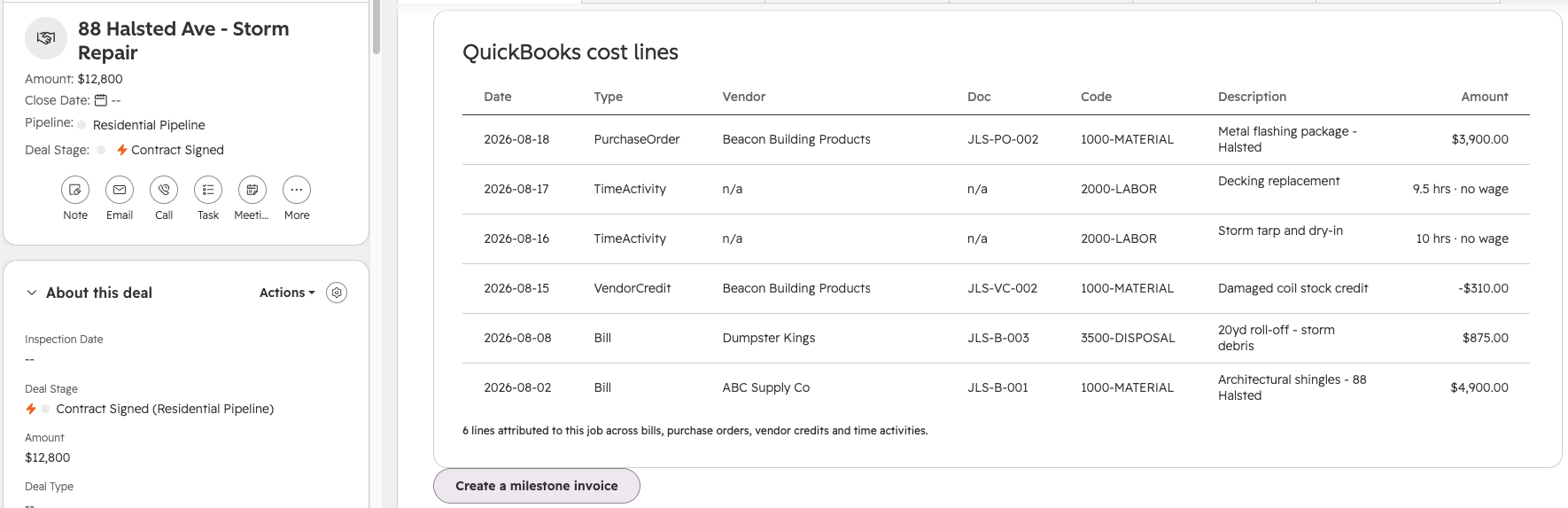
An actual screen from the product, captured on the live fixture deal; screen-recorder cursor removed. The bucket table foots to the same $16,070.50 the top of the panel reports, because the rollup and the drill-down are the same arithmetic.
This is the case the native connector cannot express, and it is ordinary in contracting: one supplier delivers to two roofs on one invoice.
Delivery to two properties
$11,000.00One bill, two roofs — handled. A real supplier bill from the demo company, split at line level so each job carries its own cost. The native connector has no job-level cost at all, so this bill would land on neither deal.
A roof is one deal, many bills, and several invoices over weeks. Handled is built around that shape rather than around a single sale.
One bill split across two jobs, per line. Rolled up by cost code on the deal.
At completion, and realised so far. Realised stays withheld until something is billed or received.
Schedules compute to the cent. A person approves each invoice before it posts, unless an admin switches on automatic posting.
A posted invoice appears on the deal with its line items and its real status.
All three mechanisms, with the screens and the constraint that enforces them
A workflow tool wired to push records across. A connector from the marketplace. A spreadsheet somebody rebuilds every Friday. Each one moves data, and none of them tells you whether the job made money.
HubSpot ships its own QuickBooks connector, and for contacts and simple invoices it is genuinely fine. Three limits matter to contractors, and they are the three things Handled was built to close.
The full comparison, row by row, with the status of every claim
Why we built it
Roofing Business Partner is a roofing business consultancy. Company after company brought us the same reconciliation, and we answered it by hand across thirty-two live integrations held together in Make.com. Handled is what we built to stop doing that.

Roofing Business Partner is a HubSpot Solutions Partner at Diamond tier.
Self-serve signup is not open yet, so there is no checkout to click. Talk to us and we will set you up directly, on a QuickBooks sandbox set up with jobs like yours, for fourteen days with no card — fourteen rather than seven because progress billing is the whole claim, and a week can easily contain no real draw at all.
Handled is new. The docs page marks every capability with its status, and nothing on this site claims a capability that does not exist.